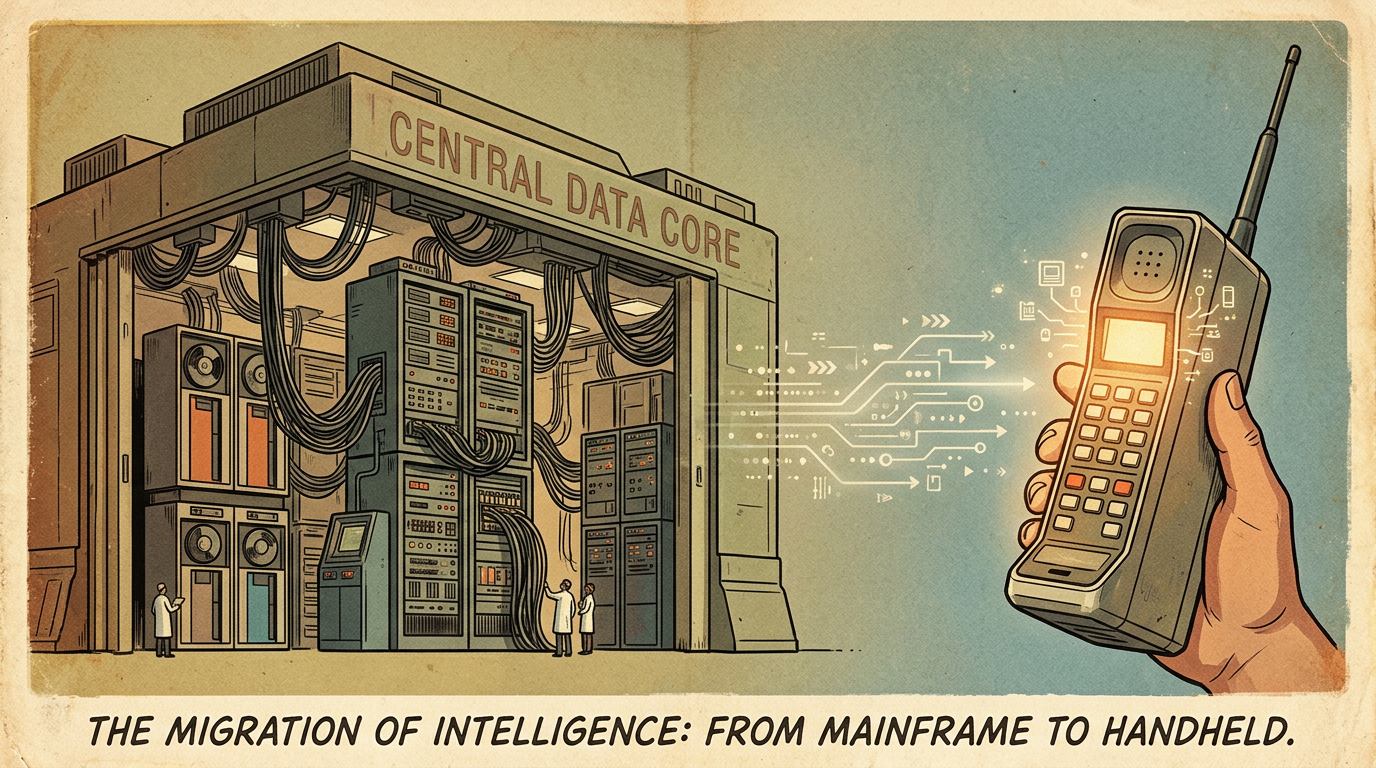
While the world is busy building enormous cloud infrastructures, Apple is betting on something radically different: bringing artificial intelligence directly to the palm of your hand.
Listening to the legendary BlackBox podcast these days, I realised how, in recent years, we have arrived at what we saw two years ago in the automotive sector.
Many years ago, it was clear that cars would be transformed into small data centres on four wheels. Today, robotaxis are a clear example of this. Fully autonomous cars that collect data and information 24 hours a day.
Apple is quietly building its own “AI internet”, starting from where no one else is really strong: the phone in your pocket. The decision to bring artificial intelligence models directly to iPhones, iPads and Macs could profoundly change not only the technology market, but also our daily relationship with data and digital technology.
‘A distributed computing and AI network will be created. And I’m with Apple for life.’
Brera Guido Maria Black Box La scatola nera della finanza
There has been a dominant narrative in the technology industry in recent years: artificial intelligence is a matter of scale. More GPUs, more data centres, more energy, more billions invested. OpenAI, Google, Microsoft — all are racing in the same direction, building monumental infrastructures that consume the energy equivalent of entire cities. Apple, on the other hand, is moving almost silently towards a completely different horizon.
The question we should be asking is not ‘who is investing the most in AI?’, but rather: where does the artificial intelligence of the future really live? In large data centres thousands of kilometres away from you, or in the device you carry in your pocket?
The data centre paradox
Large data centres are powerful, but they come with a huge burden. They require industrial quantities of energy to operate and cool. They are extremely difficult infrastructures to scale quickly — you can’t build a data centre in six months. Every request you make to ChatGPT or Gemini makes a round trip across intercontinental networks, with latency, costs and, above all, your data passing through servers that you do not control.
Some refer to these giants as “devil’s mills” — a powerful metaphor to describe structures that are necessary but distant, opaque and difficult to govern democratically. This is not a moral judgement, it is a structural observation: centralised AI in large clouds creates enormous dependencies, both for users and for nations.
| Energy | Data centres consume an increasing share of global electricity. This trend is unsustainable in the long term. |
| Privacy | Every query sent to the cloud is data transferred. Millions of daily interactions build increasingly detailed profiles. |
| Latency | Response speed depends on the connection. In a hyperconnected world, latency remains a real limitation. |
These are recurring themes in my Data Center articles
There is a fantastic podcast by Philipp Raasch that talks about the same thing in the automotive sector.
Apple’s silent strategy
Apple has always had a unique approach: controlling both hardware and software, creating closed but coherent ecosystems, investing in the entire technology vertical. This approach, often criticised as a “walled garden”, is now proving to be an extraordinary strategic asset in the context of AI.
With the new A19 series chips — designed specifically for local artificial intelligence processing — and the Neural Engine built into the latest iPad Air and MacBook models, Apple is building something that no competitor can easily replicate: a distributed network of over two billion smart devices, each capable of running AI models directly on the device.
2B+ active Apple devices worldwide
0% personal data sent to the cloud with on-device AI
3 levels of distributed AI model: device, cloud, data centre
∞ potential for scaling without building new infrastructure
A three-tier model
The vision that emerges is not one of replacing the cloud, but rather a three-tier architecture: the personal device for everyday tasks (assisted writing, summarising, image processing, personal assistant), the cloud for more complex tasks requiring medium-scale models, and large data centres for truly intensive calculations such as algorithmic trading, scientific research and massive rendering.
In this scheme, the consumer — the average person — lives in the device universe. Data remains local. Responses are immediate. Privacy is structural, not promised. And Apple, which controls the hardware, the operating system, the application ecosystem, and now even dedicated AI chips, is in a position that Google and Microsoft cannot easily achieve.
Replacing OpenAI with Gemini within Siri is not just a change of supplier. It is a sign that Apple does not want to depend on any single AI partner. The real gamble is on enhanced Siri, not on a third-party model.
Not forgetting the third wheel, CLAUDE. Who can be transformed into a highly efficient personal assistant.
Read this tutorial Turn Claude Cowork Into Your Personal COO
When compared to Apple, OpenAI’s structural fragility becomes clear. OpenAI is a company that burns through billions every year on infrastructure, depends on fragile commercial partnerships (the largest of which is with Microsoft), and has structured its strategy around a centralised model at a time when the market is moving towards distribution.
This is not to say that OpenAI will fail — large language models will continue to play a key role in professional and scientific applications. But the idea that OpenAI can conquer the mass consumer market with a cloud-first approach, while Apple offers privacy, speed and native integration, seems increasingly difficult to sustain.
Privacy and control: the secret weapon
The real strength of this strategy is not only technological, but also political and cultural: the data remains on the device.
- Personal information does not have to be constantly sent to the cloud.
- The user has greater implicit control over what is processed.
- Data traffic is reduced and, potentially, so are some of the infrastructure and energy costs.
Apple’s strategy is almost the exact opposite of that of the big AI players born in the cloud.
While many are focusing on giant centralised models, Apple is trying to: If this vision takes hold, we could see: It’s a huge gamble: less “wow” than a new model in the cloud, but much more rooted in our actual habits.
- Move part of the intelligence to the edge (on the device).
- Use the cloud only where it is really needed (tasks that are too heavy or shared).
- Vertically integrate hardware, operating system and AI, controlling the entire supply chain.
- Consumers and everyday life increasingly moving towards AI on smartphones and laptops.
- Large data centres focusing on enterprise needs: trading, research, simulations, global services.
- A distributed computing network in which billions of Apple devices become the true frontier infrastructure of AI.
Conclusion: the future is already here
There is one final consideration worth making when looking at the economics of AI in the coming years. Regardless of who wins the model war, there is a physical infrastructure that will still need to be built: electrical grids, copper to transmit energy, gold and silver as building materials, but also strategic reserves, water, and cooling systems for data centres that will continue to exist.
Those who invest in the physical infrastructure of AI, in energy and cooling, are positioning themselves to reap the rewards regardless of who wins the model competition. It is perhaps the most solid bet in a still very uncertain landscape.
The AI revolution in mobile devices is not a promise for the future. It is already underway, silently, chip after chip, update after update. Apple has not launched a chatbot, nor has it made any big announcements with astronomical numbers of parameters. It has simply built — with its characteristic patience — the foundations of an AI ecosystem that does not need to ask permission from any remote server to function.
In a world where personal data has become the most valuable commodity, having artificial intelligence that works for you and on your device is not just a technological choice. It is a political choice. And Apple knows this very well.