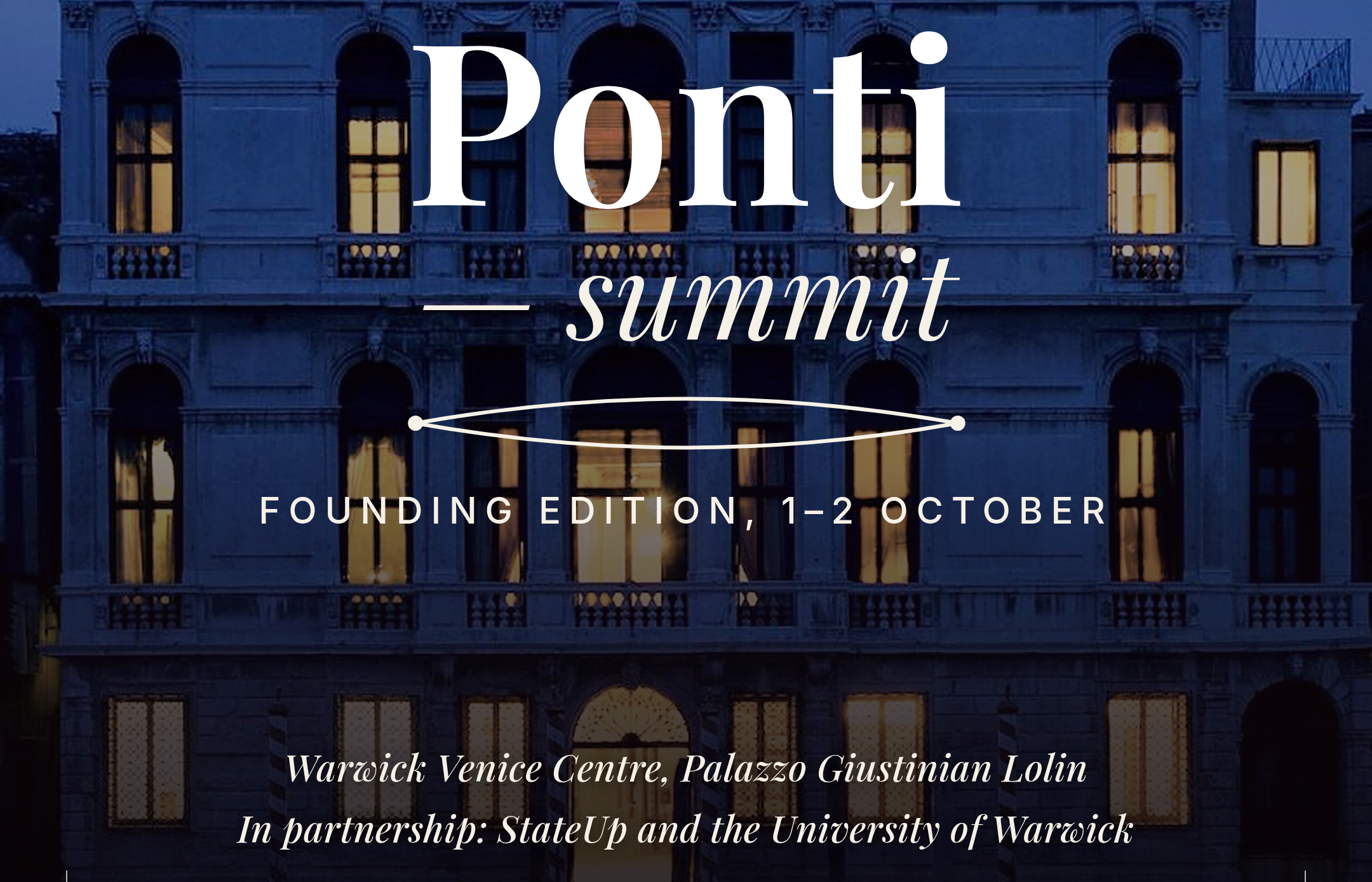
Last week, I had the pleasure of taking part in the inaugural Ponti Summit in Venice, organised by StateUp and the University of Warwick.
The name is no accident. Ponti means “bridges”: between research and industry, capital and innovation, infrastructure, institutions and companies. And, in this case, between Italy, the UK and a Europe that must decide what role it wants to play in the emerging global geography of technology.
On Thursday evening, several participants told me they were meeting people they would not normally encounter in their day-to-day work. That was intentional. Hearing it reinforced my sense that Ponti’s real value lies in connecting capabilities that already exist, but are too often developed in separate clusters.
I arrived in Venice with a question that feels increasingly important: does Europe really have what it takes to be a protagonist in the next phase of AI and critical technologies?
After Ponti, my answer is yes.
Many of the capabilities are already here. The challenge is connecting them.
Not just AI
AI is not only about models and software. It is also physical: chips, data centres, energy, storage, materials and networks. And increasingly, it will mean connecting high-performance computing and quantum technologies to the infrastructure we already have.
The Summit was structured around four themes: the European compute stack; energy for compute and compute for energy; turning research into strategic companies; and putting technology to work in critical systems.
When we talk about European technological resilience, it is tempting to think that a European AI model, or a new set of rules, will be enough. It will not.
Resilience spans the entire stack: energy, chips, compute, data, capital and, crucially, the ability to turn technology into products, companies and infrastructure at scale.

Alberto Sangiovanni-Vincentelli set the challenge Create, don’t copy
“If you try to copy what other countries or companies have done, you’ll fail. You need to create instead.”
Capital, and the people in the room
Capital is fundamental. Excellent research is not enough. It has to become a company, and that company needs funding, infrastructure and customers.
That is why it felt fitting to end the day with the Capital Commons, focused on identifying opportunities worth pursuing beyond Venice.
But another important part of Ponti was simply who was in the room: researchers, supercomputing centres, investors, industrial companies, financial institutions and government.
These communities do not work together nearly enough.
Europe has many of the ingredients. What it lacks is a system that connects them effectively. We need stronger links between these worlds, and a shorter path from research to business, from infrastructure to industry, and from capital to strategic technology.

A European question
This matters a lot for Europe. Strong in research, supercomputing, advanced manufacturing, energy and materials. The question is whether we can connect them, and plug them into wider European and international alliances.
No European country alone will match the scale of the US or China. The answer is not going it alone. It is strategic interdependence: deciding where to build our own capabilities, where to partner, and where we must avoid depending too much on others.
My main takeaway is simple. In Europe, we talk a lot about AI, regulation and digital resilience, and these things matter. But what will decide the outcome is how well we can build things like companies, infrastructure, computing capacity, technology supply chains and patient capital for deep tech. Most importantly, we need to build relationships between people who have different parts of the same puzzle.
Technological resilience is not declared. It has been built. Europe already has its riverbanks. Now, it must build the bridges. Venice was the perfect place to start.